

Pararge aegeria
Key Facts:
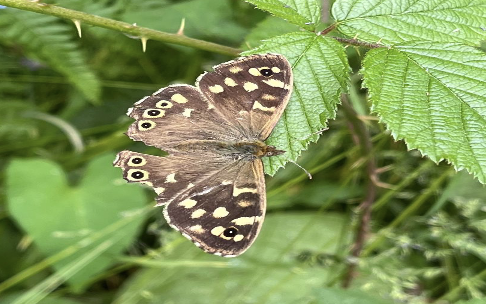
Colour: Dark brown with yellow spots
Adult Size: Roughly 5cm wingspan (males are marginally smaller)
Lifespan: 7-20 days
Where: Native to Europe
Description
Colours and Gender Differences
They can be identified by their large brown wings, resembling autumn leaves, and the yellow spots scattered around them, which tend to be smaller in males compared to female. Male Speckled Wood have a much darker colouring compared to females and smaller yellow spots, akin to the little stars you may spot in the night sky, so be sure to be take in their grace the next time you spot one of these winged wonders.
Territorial Behaviour and Reproduction
Don’t let their colourful presence distract you from the fact that they are very territorial insects; males will viciously defend their territory should another male enter the turf, where a fight will ensue as they battle for supremacy, until only one remains standing. Typically, this butterfly species will have 2 to 3 broods (eggs that were laid at similar times) per year, but this can be higher in warmer regions.
Thermoregulation and Flight
Warmer environments allow them to utilise one of their more fascinating traits, thermoregulation, meaning that they can perform certain actions such as flight better at higher body temperatures. They tend to fly closer to the ground compared to other butterfly species and can easily camouflage to create an elegant canvas at the point the Earth meets the sky, bringing them remarkably close to our everyday world.
Habitat
They can be found across the UK and Europe within various habitats, mainly woodlands, grasslands, and hedgerows, or any shaded areas with dappled sunlight where they can easily blend in with their surroundings. This means you may spot them in the various parks located throughout Tower Hamlets like Victoria Park.
Lifecycle
The lifecycle of a Speckled Wood is intriguing. It begins when a female lays an egg onto a host plant. Imagine this then hatches, giving life to a hungry caterpillar that will begin feeding on plant species including Yorkshire Fog, Common Couch and more. During their time as a caterpillar, they will shed their skin multiple times, like getting a fresh new outfit, allowing them to grow. This shedding process is known as moulting and occurs roughly 2-3 times, after which they will seek a safe and suitable area to form a chrysalis and undergo the process of pupation over the course of a few more weeks or even a month to transform into an adult Speckled Wood butterfly where it can begin exploring the world around it. From this point they will feed on nectar from flowers like brambles and dandelions, contributing to pollination while searching for a mate to start the cycle again. Isn’t that just incredible?

In certain societies, the presence of a brown butterfly entering a home is considered an unfavorable sign. Additionally, they are believed to act as messengers from the underworld in various global folklore


 BioCapture