

Anguis fragilis
Key Facts:
Colour: Golden / Grey / Brown, females can have a dark line down their back
Adult Size: length 40 – 50 cm long
Lifespan: 20 – 30 years
Where: Often found in gardens, grassland, heathland and woodlands
Description
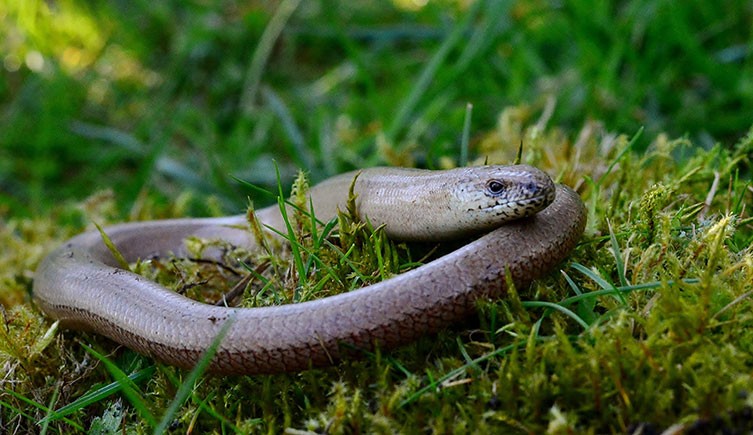
Slow-worms are often mistaken for snakes, although they are in fact lizards, and there are a few key features that can help you identify one from the other. Firstly, they are a lot smaller than snakes and have pale, smooth skin. They also don’t have a very distinct head shape or neck region, as it seems to blend into the body. If you manage to get closer, you can see that a slow-worm has a more notched tongue, which they have to open slightly to stick out. Snakes have a more forked appearance, which they can stick out with their mouth closed. Slow-worms are also able to blink! Snakes do not have eyelids.
 These slow worms are protected under the Wildlife and Countryside Act 1981; it is illegal to deliberately kill, injure or sell / trade the animals. They should also be left alone, due to their defence mechanism potentially meaning they lose a tail.
Habitat
These legless lizards prefer to stay hidden in cooler areas, and can burrow themselves to hibernate in the winter from around October to late March. This is unlike some other lizards which like to bask out in the opne instead. They usually choose to hide under logs or in compost heaps, where they can find slow-moving prey such as slugs. They are quite elusive creatures but are still common.
Lifecycle
Female slow worms incubate their eggs internally and lay them in summer. The process is called ‘ovoviviparity’. This incubation means there is no need to make a nest, and it is particularly advantageous in unpredictable weather, such as that in the UK! Once hatched, the small slow worms are immediately independent, and look like tiny versions of the adults.

Similarly to other lizards, slow-worms are able to drop their tails (autotomy) as a defence mechanism to confuse and distract predators! They do this by breaking one of their tail vertebrae in half… Don’t be too alarmed though, as they can regenerate and grow back their tails after such an event.


 BioCapture