

Tilia Cordata
Key Facts:
Colour: Dark green leaves, white flowers
Adult Size: up to 30m tall
Lifespan: Around 400 years
Where: Common around London, UK, Europe

Description
Size and Shape
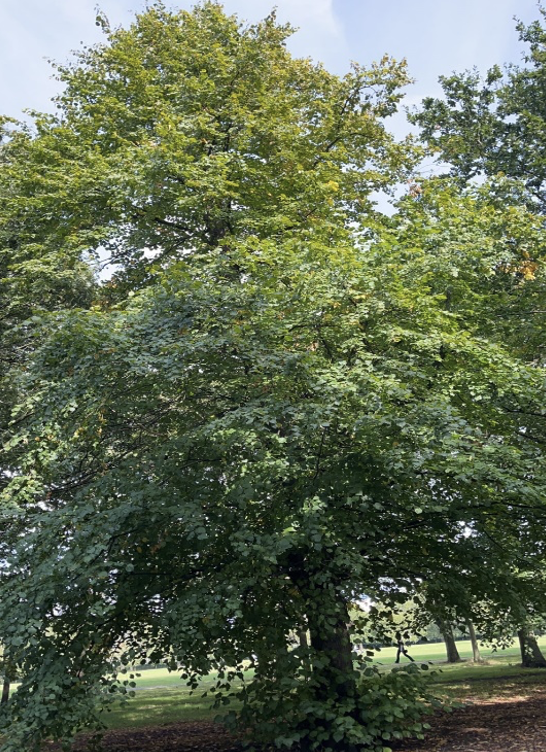
These trees can grow to a decent size, reaching up to 30 meters tall, displaying a mystical pyramid shape and ascending branches.
Leaf Characteristics
It is easy to confuse these trees with their other Tilia cousins, but pay close attention to the leaves, the key differences are their much smaller and glossy green leaves, growing up to 8 centimetres long in a heart shape with jagged edges. In contrast, similar trees like the Tilia platyphyllos have much darker and larger leaves which are typically around 12 centimetres.
Flowers and Fragrance
Despite their unassuming exterior, these trees conceal a hidden gem, clusters of small, creamy-white flowers that have a sensationally serene scent, which draws in pollinators like bees. Small-leaved lime trees have greyish bark that gets increasingly ridged and fissured with age, a testament to the wisdom of experiences gained through the course of time. Small-leaved lime have a vast variety of applications. In addition to being an excellent source of firewood, the pale wood they provide can also be masterfully crafted into different musical instruments.
Calming Properties and Urban Adaptability
One other renowned aspect of these trees are their flowers, which have been proven to exhibit calming properties like reduced stress and alleviating sleeplessness, so the next time you have a cup of linden tea, think about the source of this tranquillity, and appreciate these delightful trees. Their aesthetic isn’t the only aspect that makes them a perfect fit into urban environments, they’re also prized for their visual charm and the lovely fragrance they provide. Furthermore, they provide ample shade with their vast canopies, and can block wind for other organisms due to their size, so they create the ideal spot to be on a hot summer day when you’re out for a picnic with family.
Habitat
These trees are as European as they come, they’re quite common in many areas of London, including the bustling borough of Tower Hamlets. They’re naturally found in areas like woodlands with well-drained, fertile soil but are often planted as ornamental trees along streets and parks to liven up the environment. You’ve definitely come across them in your daily cityscape, offering a dash of green to London’s charm.
Lifecycle
As with most plants, this cycle begins with the crucial step of germination, where seeds from a grown small-leaved lime tree will fall and embark on their journey, carried by wind or water to look for a suitable spot and sprout. The seed will then develop into a seedling, which is a vulnerable state for them, so, just like a child, they require a lot of care when handling to protect them from environmental factors such as wind. This is followed by the tree developing its roots, stems and leaves, and this process will continue for just over a decade, at which point it can begin moving onto its reproductive stage. Are you surprised by just how long it takes to reach this stage? Well, that’s just the start, in favourable environments, these trees can survive for an unthinkable amount of time, up to half a millennium, yes, a whopping 500 years. Isn’t that crazy to think about?
Once the flowers have started to bloom, it’s like a buffet that pollinators won’t be able to resist and will assist in pollination just to get a taste of the delicious nectar. Seed production can now begin. As the years pass, so too does every living organism’s health, and trees too slowly start experiencing the toll of time, being more prone to disease in a process known as senescence, which is followed by them providing their nutrients back to the Earth, paving the way for the next generation.

Some Small-Leaved Lime trees have been known to grow to over 1,000 years old!


 BioCapture